Toronto’s Nuit Blanche marks 20 years with an overnight celebration of public art
More than 70 projects were programmed for the October 3–4 event under the theme Tomorrow’s Memories.
The Canadian
Culture
October 4, 2026
3 min read

More than 70 projects were programmed for the October 3–4 event under the theme Tomorrow’s Memories.
The Canadian
Culture
October 4, 2026
3 min read
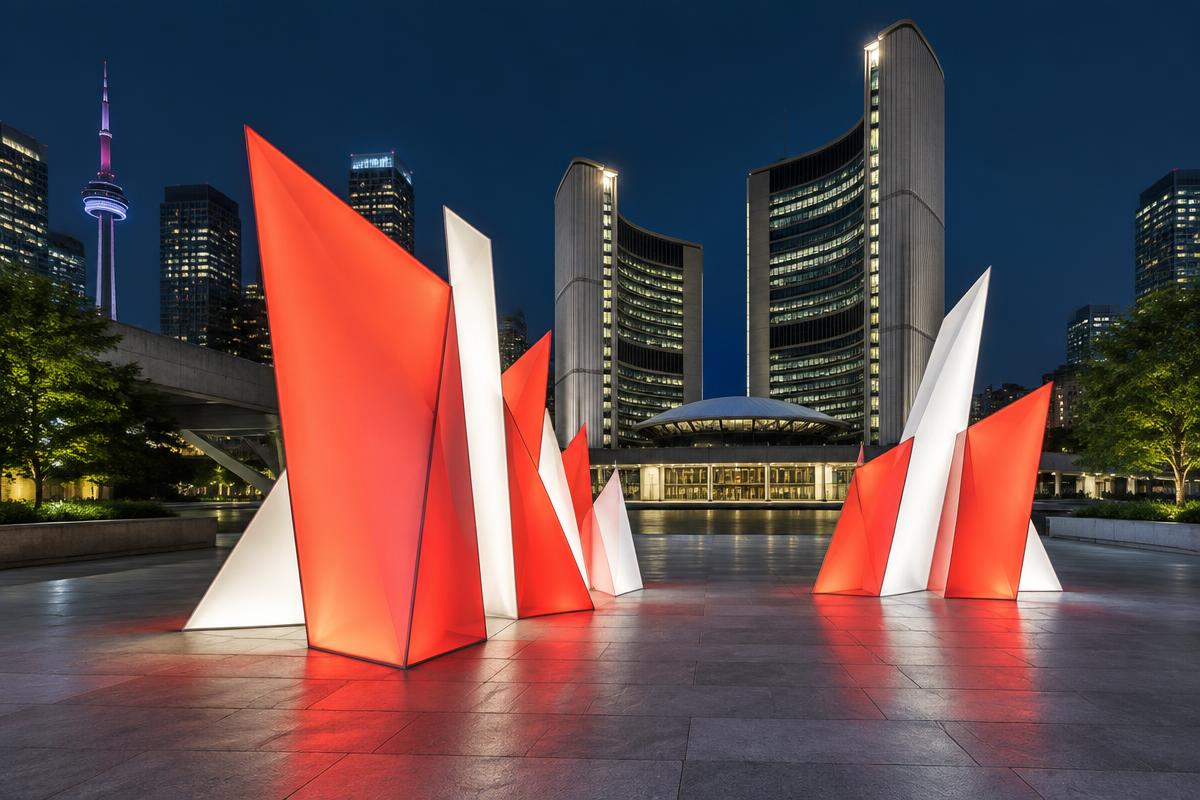
Toronto’s Nuit Blanche reached its 20th anniversary this weekend, with the free contemporary-art event scheduled from 7 p.m. Saturday, October 3, to 7 a.m. Sunday. The anniversary edition brought an overnight program to public spaces under the theme Tomorrow’s Memories, linking the event’s history with the impressions it hopes to leave for the future.
More than 70 projects by local, national and international artists, institutions and community partners were included in the program, according to CP24’s preview. The footprint extended across the downtown core and waterfront, with work also planned in Etobicoke and North York. That spread positioned the event as a city-wide encounter rather than a single exhibition.
The City of Toronto’s travel guide identified a central cluster around City Hall and Nathan Phillips Square, Old City Hall, Trinity Square and the Church of the Holy Trinity. Its listings placed contemporary works within civic spaces that normally serve very different purposes, making familiar streets and buildings part of the viewing experience.
Transport was an important part of the overnight plan. CP24 reported that TTC subway lines 1 and 2 would remain open through to the regular Sunday morning opening at 8 a.m. That arrangement was intended to connect the hours of the art program with the practical needs of visitors moving between locations.
The city’s published map also included a Remote Access Hub led by Tangled Art + Disability, with online streaming, ASL, audio description and shared access to projects. Accessibility was therefore part of the event’s published provision, not simply a question of whether individual installations could be reached on foot.
The anniversary is a marker of how temporary art can become a recurring part of a city’s cultural life. This report draws on the published program and advance reporting; it does not claim an independently verified attendance total or assess individual performances. What the edition established was an ambitious framework for making public space an overnight venue for contemporary art.

The Canadian · October 28, 2026

The Canadian · October 23, 2026

The Canadian · October 17, 2026